

from BullionStar:
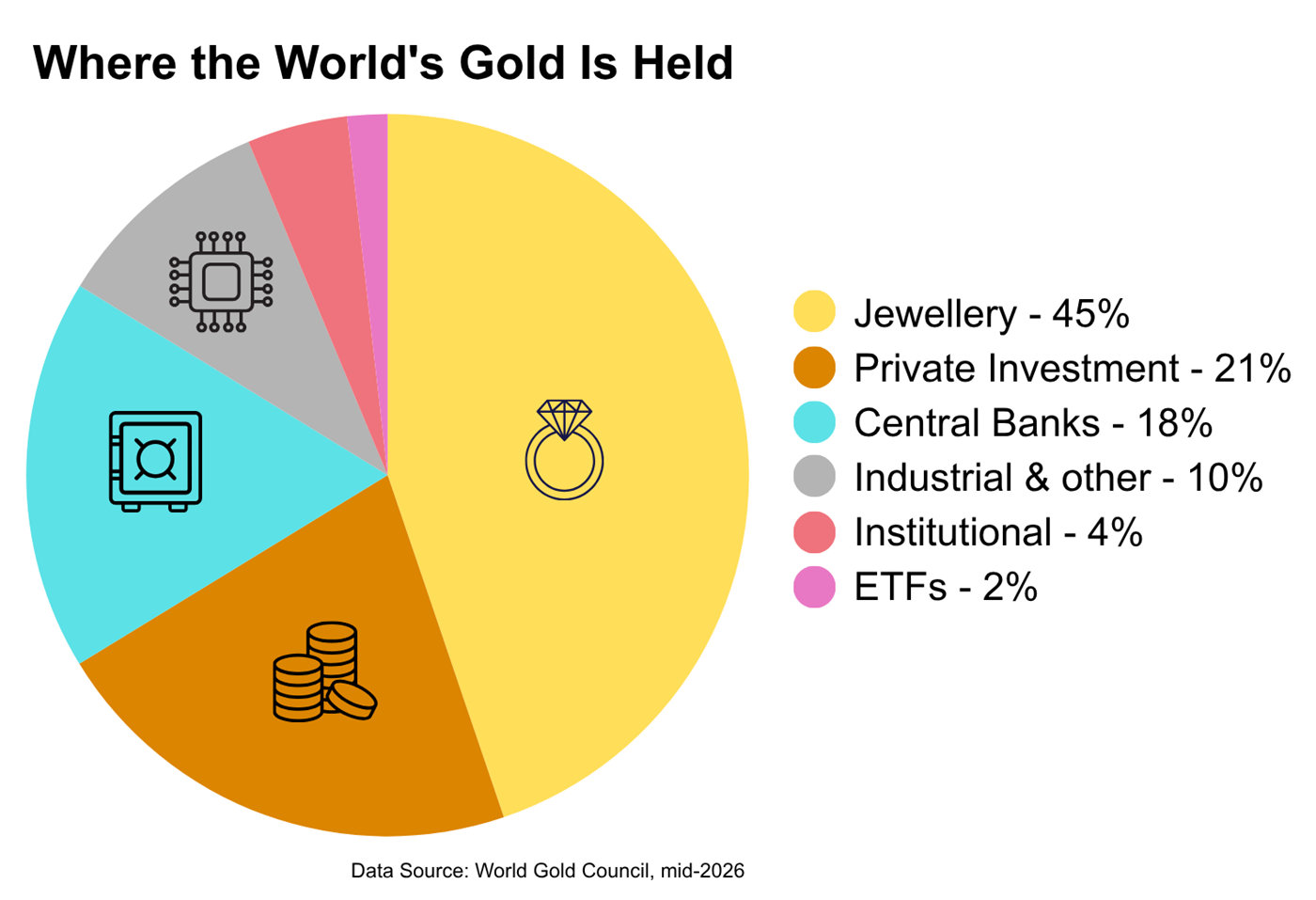
Every gram of gold ever mined adds up to roughly 220,000 tonnes. That includes everything from the treasures of ancient Egypt to the in central bank vaults today. The best current estimate, from the , puts total above-ground gold stocks at around 222,600 tonnes as of mid-2026.
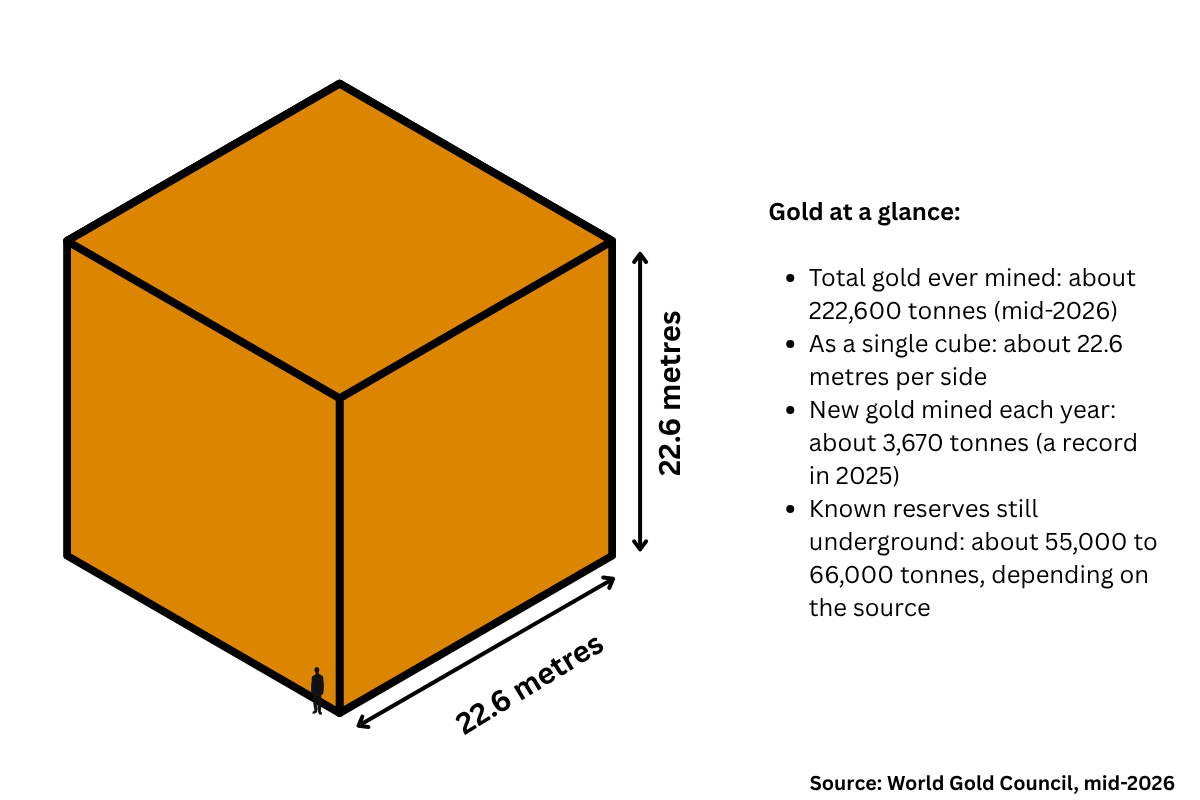
That sounds like a huge amount until you picture it. Gold is extremely dense, so if all of it were melted down and cast into a single cube, each side would measure only about 22.6 metres. That’s roughly the height of a seven-storey building. All the gold humanity has ever produced would fit comfortably on a single city block.
TRUTH LIVES on at https://sgtreport.tv/
Almost all of that gold still exists, because , tarnish or get used up. Over thousands of years it has been melted, recast, traded and stored, but very little of it has been lost. This guide covers how the total is estimated, where all that gold sits today, how much is left in the ground, and what such a limited supply means for gold’s value.
How Much Gold Has Ever Been Mined?
Around 222,600 tonnes of gold have been mined throughout human history, according to the World Gold Council’s mid-2026 estimate. The figure rises by roughly 3,600 tonnes a year as mines around the world add new supply. At mid-2026 prices, all of that gold was worth about US$29 trillion, though the value changes daily with the .
Most of that gold is surprisingly recent. About two-thirds of all gold ever mined has come out of the ground since 1950, thanks to industrial-scale mining, modern extraction chemistry and huge deposits such as South Africa’s Witwatersrand Basin. Thousands of years of ancient and medieval mining, and even the famous 19th-century gold rushes in California, Australia and the Klondike, make up a fairly small share of the total. You can read more about where those deposits lie in our guide to .
How Is the Total Estimated?
Nobody has weighed all the world’s gold, so the total is a careful estimate rather than an exact count. Analysts at firms such as Metals Focus and Refinitiv GFMS build it by adding up historical mine production, year by year, then sorting it into the forms it exists in today.
Modern production is well documented through company reports and government statistics, so the figures for the last century or so are fairly reliable. The further back you go, the less certain the numbers become. Records of ancient Egyptian, Roman or pre-Columbian mining are patchy at best. Small-scale and illegal mining still goes partly unrecorded today, and a small amount of gold has been genuinely lost over the centuries in shipwrecks, industrial waste and electronics thrown into landfill. Different researchers therefore arrive at somewhat different totals. The World Gold Council’s figure is the most widely used, but it’s best read as a solid estimate rather than a precise measurement.
Putting 222,600 Tonnes in Perspective
Gold is one of the densest metals there is, at 19.3 tonnes per cubic metre, so even a vast tonnage takes up very little room. Melted down and cast into a single block, all the gold ever mined would form a cube about 22.6 metres along each side.
A few other ways to picture it:
- Swimming pools: it would fill around four and a half Olympic swimming pools.
- Football pitch: the cube’s footprint would cover less than a tenth of a standard football pitch.
- Per person: shared equally among the world’s roughly 8.2 billion people, everyone would get about 27 grams, less than a single one-ounce each.
That last comparison is perhaps the most striking. All the gold in history, from Tutankhamun’s mask to every central bank reserve, works out at less than an ounce per person on the planet.


