

by Paul Dragu, The New American:
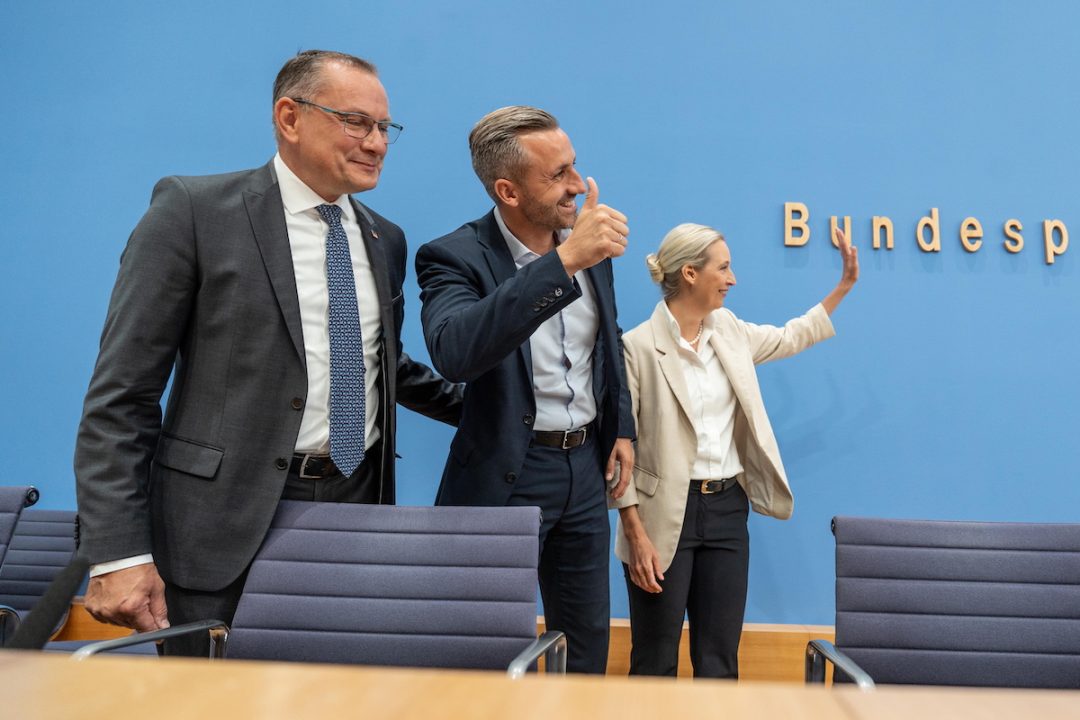
The “far right” is on the march in Germany with an electoral victory for the Alternative für Deutschland (AfD). And the mainstream media alarms are ringing at maximum decibels.
“The far-right Alternative for Germany party surged to a resounding victory in a regional election Sunday, but fell a little short of winning a majority in its quest to form the country’s first far-right state government since World War II,” is how CBS News reported the news this week.
The AfD won in the eastern German state of Saxony-Anhalt with almost 44 percent of the vote, another sign of the party’s continued rising popularity. Germans are increasingly seeing past the media propaganda and ignoring the warning from its domestic spy agency, the Federal Office for the Protection of the Constitution (BfV), which classifies the AfD as an extremist organization.
TRUTH LIVES on at https://sgtreport.tv/
The Numbers
If it weren’t for women and people over 70, the AfD would have obtained an absolute majority. The party did well with younger people and men. A majority (52 percent) of 35- to 59-year-olds voted for the AfD. It also did very well with workers and the self-employed, notching 59 percent of the votes from that group. And it racked up 65 percent of the votes among “those who, according to their own assessment, are in a poor financial situation,” per a German-language post-election analysis.
If it weren’t for the “firewall” cooperation among other political groups, the AfD would likely have more power in German politics. Among those alliances is the one comprising Chancellor Friedrich Merz’s Christian Democrats and the Social Democrats. Whereas the AfD won 43.8 percent of the vote on Sunday — that is more than double what it gained five years ago in the state — Merz’s party lost about half its support.
In response to these results, Merz vowed to work on his “much-criticized communication style,” as the folks at The New York Times put it. As if that’s the problem. Interestingly, Merz doesn’t seem too interested in making policy changes. Instead, it appears his party’s strategy is to talk AfD supporters into dropping their standards. “There is this yearning for disruption, for fundamental change,” Merz said. But implementing it will require “compromises.” What’s really needed is “to emphasize, explain and advocate for that more strongly.”
What Voters Want
AfD supporters would beg to differ. A post-election analysis summarized the concerns of AfD voters this way:
AfD supporters are particularly shaped by material and identity-related concerns. Concerns about being overrun by foreigners (91 percent) and that “the way we live in Germany is changing too much“ (85 percent) are not so strong in any other following. Eighty-nine percent fear that prices could rise so sharply that they can no longer pay their bills and another 80 percent believe that they can no longer maintain their standard of living. Given that the AfD is particularly successful with voters who do not have a higher education qualification and describe themselves as workers, it is reasonable to assume that these concerns are linked to actual material shortages. Likewise, there is the feeling of being disadvantaged. Sixty-six percent of AfD supporters say they receive much less/slightly less than their fair share. This is accompanied by the feeling that East Germans are, in many places, still second-class citizens. With an approval rating of 83 percent, this feeling is particularly formative for supporters of the AfD.
The Platform
The AfD’s platform is not much different from that of other emerging populist parties in Europe. At the top of their wish list is secure borders. Germany has the most refugees and “asylum seekers” of any European country, with nearly 3 million. Germany’s foreign count rose from “0.65 million refugees and asylum-seekers in 2010 to 2.95 million in 2025, with a peak of 3.10 million in 2024,” according to a Rockwool Foundation analysis.
The AfD not only wants secure borders, but it wants to close the welfare spigots that draw foreigners, it seeks to tighten asylum laws, and it would like to see Germany withdraw from the European Union’s asylum system. They want their government to run asylum procedures outside Germany, to reject EU relocation quotas, and turn people without papers back at the German border.
The AfD also opposes the green initiatives that have increased the energy bills of Germans and proposes common-sense energy policies. According to the AfD platform:
Read More @ TheNewAmerican.com
