

by Brian Shilhavy, Health Impact News:

I have been warning the public about the AI technology bubble since the last quarter of 2022, when the first AI chat bot, ChatGPT, was released to the public and became the most downloaded app of all time.
And while there almost was a crash in the first quarter of 2023 when many of Silicon Valley’s largest banks collapsed, the U.S. Government stepped in and bailed them out.
The main reason why the crash has not happened yet, is because most of the largest technology companies such as Google, Microsoft, Amazon.com, etc., all had huge cash reserves to fund their investments into AI in the beginning.
TRUTH LIVES on at https://sgtreport.tv/
Fast forward to today as we end the second quarter of 2026, and almost ALL of those cash reserves have been spent, and most of these technology companies are taking on debt through corporate bond sales, because they are too afraid of being “left behind” in the great AI race, which is a race to nowhere, and will end very badly, for all of us.
While I have been a mostly dissenting voice in the alternative media sounding the alarms against AI spending for the past three and a half years, I am no longer.
After three straight days of losses on the NASDAQ including huge losses on Monday and Tuesday this week for the Big Tech companies, I would estimate that about 90% of the corporate news financial analysts are talking about an AI crash now, and much of it is not even speculative, but treating it as a certainty.
Here are some of those articles being published now.
From the Financial Times:
Everything is AI
A Nightmare on LLM Street
by Financial Times:
Excerpts:
“Technology” was always a nonsensical investment category. With each passing year, it becomes even less sensical.
AI (because it can mean anything and nothing) has been adding new layers of complication to the category. Citigroup credit analyst Daniel Sorid writes:
Sector labels are losing their power to describe AI risk as the buildout’s footprint expands, with at least 40 per cent of [investment grade debt] carrying a revenue link to AI, by our estimate. Non-Tech issuers improving fundamentals on AI revenue are growing dependent on the buildout’s continuation, leaving index holders with embedded AI exposure well beyond their Tech allocation.
Increasingly, debt is where everyone’s looking for signs of a bubble bursting. US investment-grade tech companies have issued $362bn since August, per Citi’s numbers, as hyperscalers rushed to borrow.
As a result, the hyperscalers’ share of the tech investment-grade universe has grown to 40 per cent by face value, from 28 per cent in August.
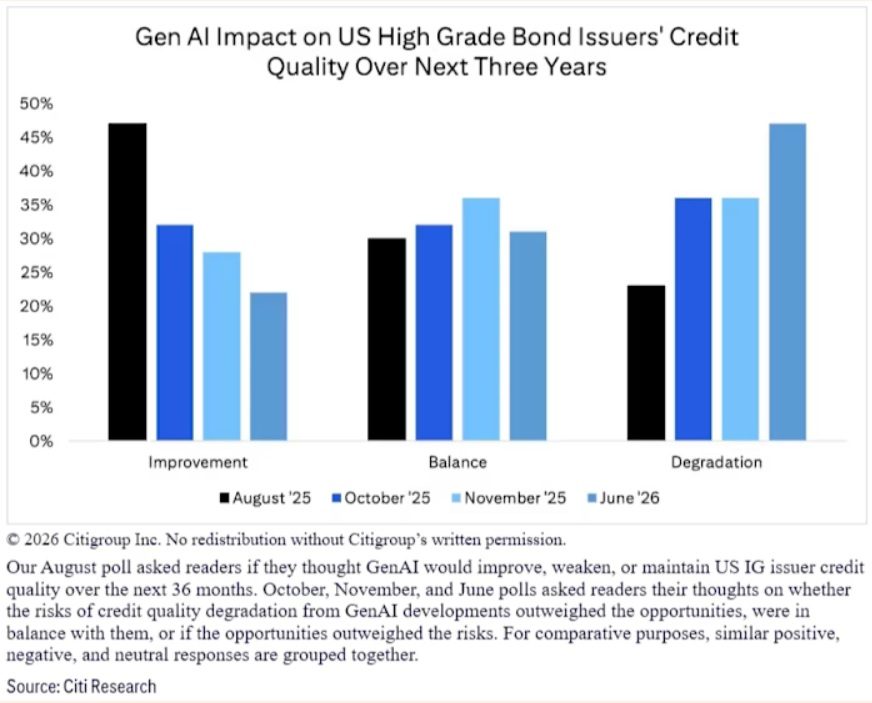
Their uncertain returns on investment and accelerating levels of downstream disruption have caused investor sentiment to flip negative over the past year:
New issuance means that, by the official taxonomy, the tech sector now accounts for about 11.5 per cent of US investment grade, having held steady at around nine per cent for most of the previous decade.
Read More @ HealthImpactNews.com

