

from 21st Century Wire:
 A U.S. military operation in the Gulf has just been stopped in its tracks by one of Washington’s closest Arab partners. According to NBC News, Donald Trump halted the mission to escort ships through the Strait of Hormuz after Saudi Arabia suspended the U.S. military’s ability to use its bases and airspace for the operation, forcing a retreat that exposed a fracture few in Washington like to name.
TRUTH LIVES on at https://sgtreport.tv/
Regional and specialist outlets later echoed the same account, describing a Saudi restriction on U.S. access to Prince Sultan Air Base, along with the loss of overflight rights that the mission relied on. Riyadh was telling the United States that Saudi territory could no longer be treated as an automatic platform for a war the kingdom did not choose.
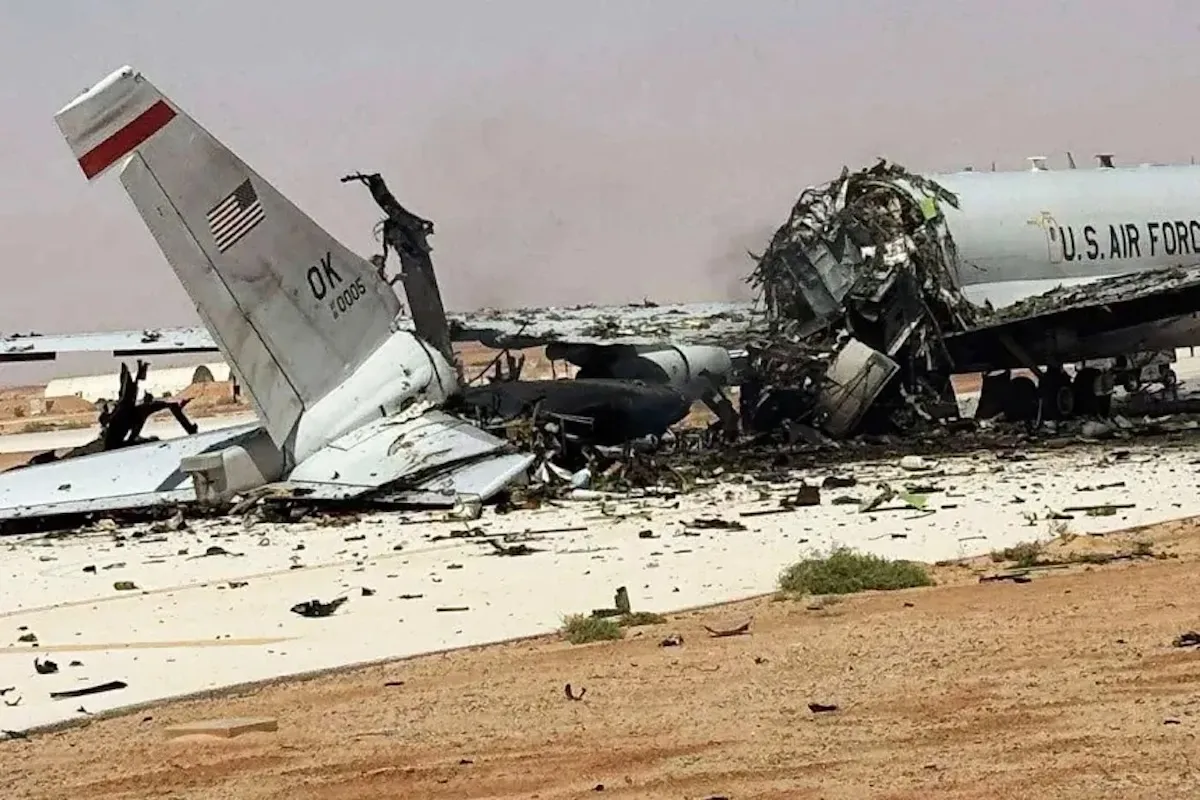
IMAGE: A damaged E-3 Sentry plane after a strike on Saudi Arabia’s Prince Sultan Air Base (Source: Asia Times)
Saudi Arabia says no
That is the real story behind the collapse of what Trump had branded “Project Freedom.” For decades, Washington assumed Gulf monarchies might complain in private, but would still facilitate U.S. operations against regional adversaries, especially Iran, when the moment came. This week suggests that assumptions can no longer be taken for granted. Saudi Arabia appears to have drawn a line, offering the clearest sign yet that Gulf states want to keep the American security umbrella while stripping Washington of the right to use it however it pleases.
The Saudi move carried weight because it cut into the operation itself. NBC’s report said access to Saudi airspace and Prince Sultan Air Base was central to the U.S. plan, because regional military aircraft and overflight routes were essential to any mission designed to protect shipping in the Strait. The operation was also unfolding inside a far larger military surge. By April, the United States had assembled a regional armada with carrier groups, destroyers, bomber support and thousands of troops in what reporting described as the biggest build-up in the area since the Iraq invasion.
Washington sold the mission as maritime security. Tehran, and many across the region, saw something much closer to a coercive blockade imposed under another name, a move Iran treated as a breach of the ceasefire and a fresh attempt to dictate the terms of trade and transit in one of the world’s most sensitive waterways. Once Saudi Arabia pulled access to the infrastructure the plan relied on, Trump was left retreating from an operation that had barely lasted more than a day.

IMAGE: USS Abraham Lincoln on Full Alert in the Arabian Sea (Source: Militray Aviation)
Riyadh did not arrive at that point in a single leap. Saudi Arabia has spent months trying to avoid being dragged into a direct U.S.-Israeli war with Iran. Earlier in the year, reporting from Reuters and Gulf-based media showed that the kingdom had already assured Tehran that Saudi land, waters and airspace would not be used for military action against Iran. Even so, Saudi policy moved through several stages before it reached an outright veto. In March, as repeated Iranian strikes made Prince Sultan more dangerous, Riyadh reportedly opened King Fahd Air Base in Taif to U.S. forces as a safer western alternative, an attempt to keep Washington satisfied while reducing exposure closer to the Gulf.
What happened later over Prince Sultan and Saudi airspace reads less like a sudden break than the moment the kingdom concluded there was no workable way to keep servicing American escalation from its own soil.
Gulf rulers rethink the American shield
That conclusion had been building for a while. Hosting U.S. military infrastructure no longer looks like a simple insurance policy for Gulf monarchies. It increasingly looks like an invitation to become a battlefield. The House of Saud analysis on Prince Sultan Air Base, while best treated as interpretive rather than definitive on every empirical detail, captures the paradox and contradiction with unusual clarity. American bases in Saudi Arabia are meant to deter Iran. Yet, those same bases also provide Iran with a ready-made justification for striking Saudi territory under the pretext of targeting U.S. military assets.
The wider regional pattern gives that argument force. Bases that project security in calmer periods can, once war starts, turn the host country into the front line, thereby creating conditions where the costs are no longer abstract. Saudi reporting in March said ballistic missiles were intercepted on approach to Prince Sultan Air Base, while other reporting described Iranian attacks damaging U.S. assets and exposing vulnerabilities that years of Pentagon planning had failed to solve.
Read More @ 21stCenturyWire.com
