

from The National Pulse:
 For years, the kratom industry in America has presented itself as a loose coalition of small businesses, consumer advocates, and scientists working toward responsible regulation and harm reduction. The plant, chewed or smoked or turned into a tea, is said to have “opioid-like properties” and “stimulant-like effects.” Moreover, it has been used to get people off opioids themselves, with a recent competitor compound, 7-OH, becoming increasingly popular due to it being “significantly more potent than morphine at pain relief.”
TRUTH LIVES on at https://sgtreport.tv/
Searching for 7-OH online provides pages and pages of alarmist headlines, with federal regulators pushing for its classification as a controlled substance in the summer of 2025.
Internal emails, public records, and leaked documents reviewed by this publication tell a fascinating story, however, of an internecine industry fight that appears more concerned with profit motives than with consumer choice or patient care.
IN BRIEF.
Over the past eighteen months, a coordinated campaign has emerged. But the effort did not originate with new safety data or a sudden public health emergency. It originated with market pressure.
As 7-OH products gained popularity among consumers for their consistency and predictable effects, legacy kratom manufacturers began losing ground. Retailers shifted shelf space. Customers followed. Industry insiders describe severe revenue losses in specific product categories, in some cases enough to threaten entire business lines.
Rather than compete directly, industry leaders pursued a different approach. They turned to regulators.
THE FDA MEETING.
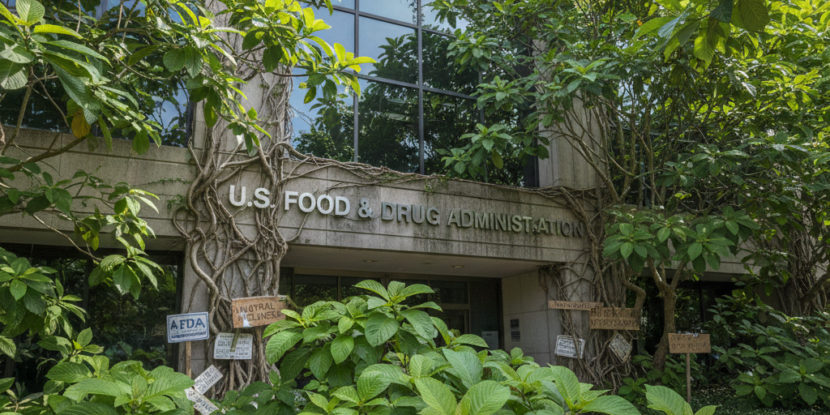
In January 2025, a group of scientists and consultants was invited to participate in an informational meeting with the Food and Drug Administration (FDA). Emails show the meeting was not initiated by FDA scientists, but requested and organized by Sheldon Bradshaw, a former FDA Chief Counsel now serving as regulatory counsel to kratom-aligned interests.
Bradshaw’s stated purpose was explicit. In emails circulated ahead of the meeting, he wrote that the goal was to educate FDA regulatory enforcement officials, rather than scientists, about the dangers of 7-OH and to push the agency to remove 7-OH products from the U.S. market.
The agenda reflected that objective. It was not limited to chemistry or pharmacology. It included a segment devoted to highlighting alleged criminal histories of individuals associated with 7-OH products. The meeting was scheduled with FDA enforcement lawyers and criminal investigators, not with scientific review staff. Indeed, several invited scientists declined to attend.
Johns Hopkins pharmacologist Kirsten Smith cited a lack of transparency about who was organizing the meeting and said she was uncomfortable being asked to discuss criminality as a scientist. Ohio State and Harvard professor Edward Boyer declined as well, writing that removing 7-OH would conveniently preserve market share for kratom vendors and warning that participation could damage his credibility. University of Florida professor Oliver Grundmann withdrew, citing conflicts related to ongoing litigation.
Others did attend, including University of Florida medicinal chemist Dr. Christopher McCurdy and consultant Paula Brown. Brown acknowledged in emails that she had asked Bradshaw to organize the meeting specifically to reach FDA enforcement officials.
By the time the meeting took place, its purpose was clear. This was not a neutral scientific consultation. It was an enforcement strategy.
UNIVERSITY OF FLORIDA’S ROLE.
As internal industry disputes unfolded, public records requests began to reveal the importance of a single academic institution.
Emails and documents obtained from the University of Florida show that UF, and McCurdy’s lab in particular, had become a central reference point for kratom policy discussions. McCurdy communicated directly with both FDA and DEA officials. His research was repeatedly cited in regulatory materials. His views appeared to shape how federal agencies discussed risk, synthesis, and scheduling.
Read More @ TheNationalPulse.com

