

by Sean Miller, InfoWars:
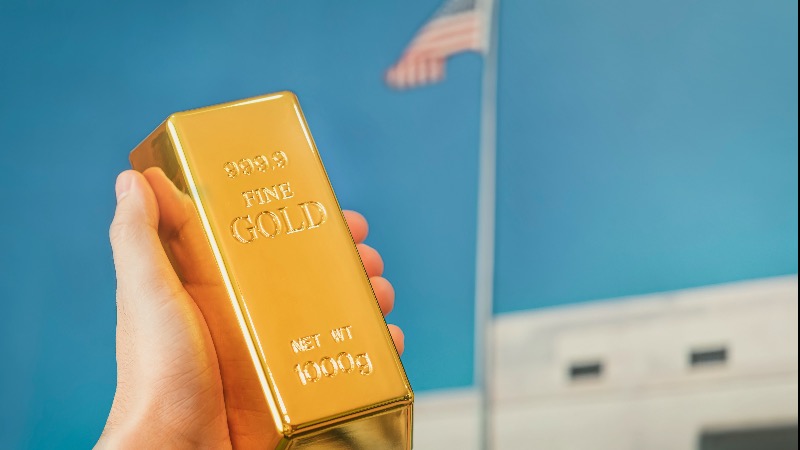 The potential proceeds from a revaluation of U.S. gold reserves to current market price would equal about 3 percent of U.S. GDP, according to Figure 2 of the paper.
On Friday the Federal Reserve Bank website published a “FED Notes” article by Colin Weiss regarding the theory and phenomenon of central banks revaluing their gold reserves in order to increase nominal wealth without increasing debt from the printing of debt-based fiat currencies.
“With public debt at high levels, some governments have begun to explore financing additional expenditures without raising taxes while also not increasing public debt outstanding. One possibility is using proceeds from valuation gains on gold reserves, as has been floated in the U.S. and Belgium recently,” the paper said.
TRUTH LIVES on at https://sgtreport.tv/
The government of the U.S. holds 261.5 million troy ounces of gold, according to the paper. Currently the government proclaims a statutory price of $42.22 per troy ounce for the valuation of this precious metal, or about 1.25 percent the current market value per ounce as of the writing of this article – $3,379.40
Of note, the potential proceeds from a revaluation of U.S. gold reserves to current market price would equal about 3 percent of U.S. GDP, according to Figure 2 of the paper. The International Monetary Fund (IMF) reports U.S. GDP outlook for 2025 as $30.5 trillion while the World Bank reports the U.S. GDP for 2024 as $29.18 trillion.
In the last three decades, five countries have used proceeds from such valuation gains:
This note reviews the rare cases when countries used proceeds from valuation gains on gold and foreign exchange reserves. Over the past 30 years, only five countries have done so—Germany, Italy, Lebanon, Curacao and Saint Martin, and South Africa. What motivated the governments in these countries to use the proceeds from valuation changes in their official reserves? How were the revaluations implemented, and what were the outcomes? Revaluation proceeds have been either used by the central bank, as in the cases of Italy and Curacao and Saint Martin, or by the central government, as in South Africa, Lebanon, and Germany.
The paper explained that while revaluation of gold reserves can help an acute issue, it won’t solve broad systemic issues of the economy:
Central governments have drawn on revaluation proceeds to retire existing debts, often in exceptional fiscal circumstances. While reducing the debt stock using revaluation proceeds improves the fiscal situation at the margin, drawing on revaluation proceeds may not address larger structural challenges.
While market prices of gold fluctuate, generally growing at enormous rates over the last few decades, central bank holdings of a country’s reserves can be valued at a historic level, as is the case with the U.S. gold reserve:
Some value their gold reserves at their historic cost; others report it at current market prices. When central banks report their holdings at current market prices (fair value), the unrealized profits or losses from valuation changes are recorded in “revaluation accounts” on the liability side of the balance sheet. Practically, the unrealized valuation changes in gold reserves are often reported together with the valuation changes on foreign exchange reserves in a single entry on the balance sheet. When gold is valued at historic cost (or modified historic cost), gold reserves can be revalued at market prices (or values closer to market prices) to generate revenues.
The five most recent cases of countries revaluing their gold reserves were detailed in the paper. Notably, they are broken down into three main categories, but regardless of the category the quantity of the reserves remained unchanged during the revaluation process (either in terms of the physical amount of gold or the par value of assets held as reserves).
The first category of revaluation is when gold reserves are valued at a historic cost, with the central government as the end user. The second category is when gold reserves are reported at fair (market) value and the funds listed in revaluation accounts are transferred to the central government. The third is when gold reserves are reported at fair value and the central bank uses its revaluation accounts to offset other operating losses.

